
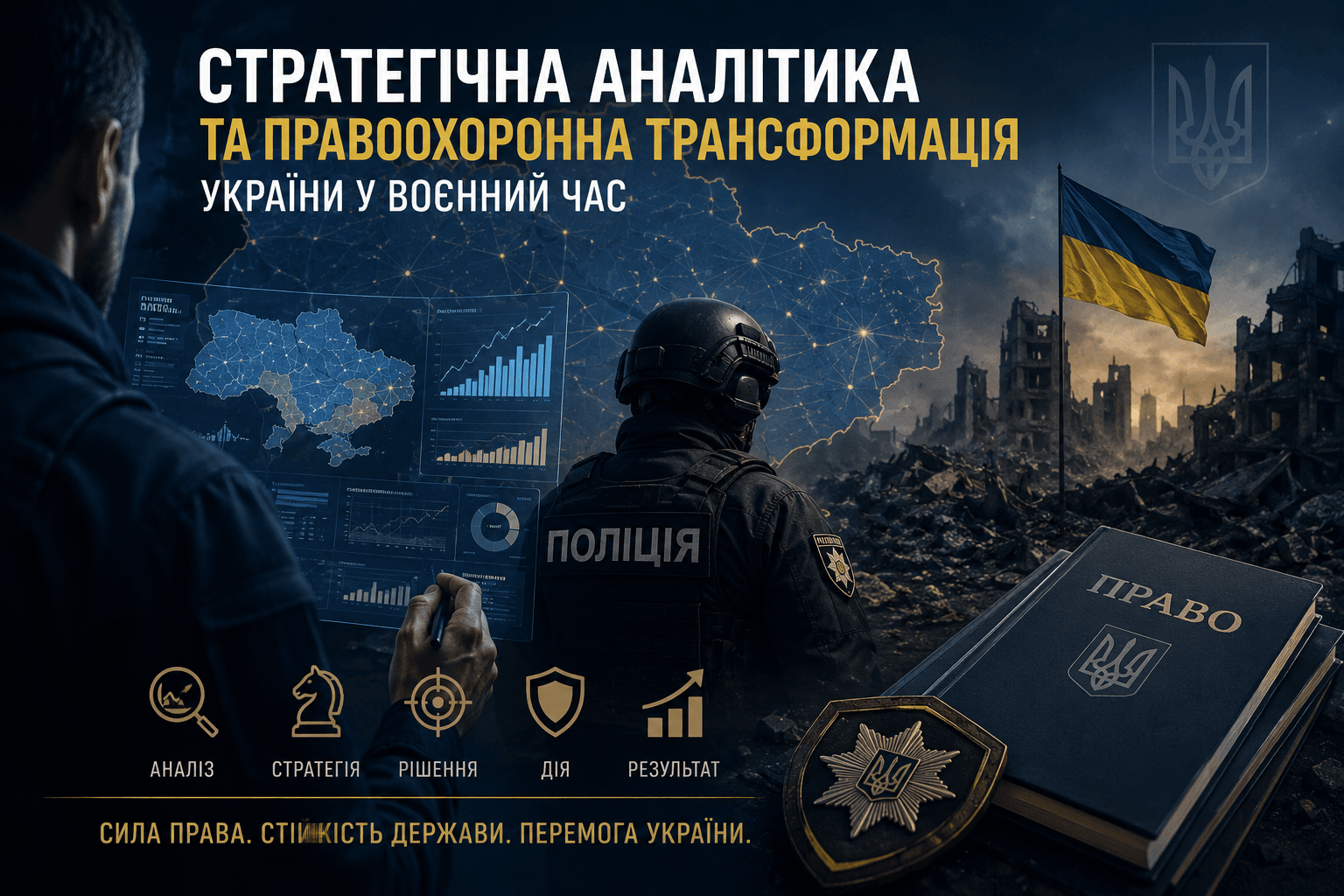
Strategic Analytics and Law Enforcement Transformation of Ukraine in Wartime
Ukraine's internal transformation today is a strategic factor no less important than the events on the frontline. For the West, the issue of state manageability is gradually becoming almost as critical as military resilience. Therefore, the strengthening of analytical intelligence, digital financial control, anti-corruption infrastructure, and the fight against organized crime directly affects the state's resilience, the level of allied support, the post-war architecture of power, and economic recovery, while simultaneously generating new risks.
Ukraine is transitioning from a post-Soviet "network" model to a system of centralized data, financial monitoring, and law enforcement analytics — effectively forming a state of military digital control. Law enforcement agencies are moving from a reactive model to a preventive and analytically driven one, while the anti-corruption vertical becomes part of geopolitics, ensuring control over the use of aid and investment guarantees. The war is destroying the old criminal-oligarchic architecture, strengthening the control of borders and financial flows.
However, risks arise. An excessive concentration of law enforcement resources can shift the balance from the rule of law to the dominance of forceful decisions: this yields quick results but threatens the politicization of investigations and pressure on business. The conflict between reform and the old elites inevitably generates sabotage and turbulence, although in the long term, it can weaken the oligarchic model. Organized crime is adapting to the wartime economy — from arms smuggling to schemes around recovery and cybercrime. Society reacts sharply to the inequality of justice, and selective punishment can cause radicalization and distrust. After the war, there is a risk of a "forceful state syndrome," when special services do not want to lose influence, but an active civil society and the European vector of integration can prevent this.
Under such conditions, it is possible to consider the following development scenarios:
Successful scenario. Ukraine holds the frontline, modernizes the state, limits oligarchic influence, creates an effective analytical law enforcement system, and integrates into European institutions. This means not only strengthening the state after the war but also forming a new governance model where a security state is combined with democratic competition. In this case, the country emerges from the war significantly stronger than it was before 2022, with a new quality of the state apparatus, greater public trust, and stable investment guarantees.
Unsuccessful scenario. If the law enforcement system becomes overly politicized, the fight against corruption is selective, and the recovery economy turns into a source of new resource redistribution, then internal trust will begin to collapse. The West will become more cautious in its support, and political instability will grow. This could lead to a rollback to authoritarian practices, where law enforcement agencies dominate democratic institutions, and society loses faith in justice and equality.
Integrated forecast. Ukraine is moving not towards collapse, but towards a complex model of wartime modernization. The main challenge of the next 3–5 years is to combine a strong security state with the preservation of a democratic competitive system. This will become the key internal strategic task after the active phase of the war.
At the same time, the current state is characterized by the fact that an asymmetry is forming in Ukraine between a high tactical level of analytical intelligence and a weak strategic level, as the state is learning to detect individual threats quite quickly, but it is forming the ability to forecast systemic risks much more slowly. This means that law enforcement agencies are increasingly better at answering the questions "what happened?" and "who is involved?" by using digital criminal analysis, open-source intelligence, financial monitoring, and automation of the evidence base, but at the same time, they weakly answer the questions "what will happen in a few years?", "what processes are already irreversible?", or "where are new criminal-political ecosystems forming?". As a result, a "state of reaction" emerges rather than a "state of forecasting," which reacts well to a crisis but does not create qualitative models of long-term foresight, which is especially dangerous in conditions of war, social trauma, demographic changes, and EU integration.
This weakness generates a number of risks: fighting consequences instead of causes, when the system documents schemes but does not forecast their emergence; the illusion of analytical modernization, when digital tools create the appearance of a strategic approach but in reality remain tactical; a lack of risk-based management, leading to a chaotic distribution of resources; the inability to forecast social instability, which can erupt suddenly after the accumulation of invisible factors; and the political vulnerability of law enforcement agencies that focus on short-term indicators and media effect rather than long horizons. The most dangerous long-term risk lies in the loss of strategic time, because if forecasting is not established now, the complexity of the system will increase sharply after the war, and institutions may simply not have time to adapt.
Under such conditions, refining the vision of the future, the following scenarios are possible:
A positive scenario assumes that Ukraine will manage to transition from tactical to strategic analytics, form a culture of forecasting and risk management, integrate methods of scenario planning and strategic foresight, and then be able to become one of the most modern security states in Europe. In such a model, the state not only reacts to crises but also anticipates them, which allows reducing systemic threats even before their manifestation, ensuring stability and the trust of society and partners.
A negative scenario consists in the fact that the strategic level will remain declarative, and the state will turn into a "digitally strong, but strategically short-sighted system" that accumulates data but does not comprehend it. In such a model, crime adapts faster than law enforcement agencies, crises accumulate unnoticed, politics becomes reactive, and governance gets overloaded, which leads to cyclical crises and a loss of trust both domestically and from the West.
An optimal scenario involves combining a strong tactical level with a gradual buildup of strategic analytics, where the state maintains operational efficiency but at the same time forms institutions of long-term forecasting, integrates risk-based governance, develops a culture of foresight, and creates mechanisms for early warning of social and economic crises. In such a model, Ukraine not only holds the frontline and modernizes the state but also gradually transitions to managing complex systems, which allows avoiding excessive politicization of law enforcement structures and ensuring a balance between security and democratic competitiveness.
The integral conclusion is that Ukraine's main hidden risk is not a lack of data, but a lack of strategic comprehension of data, because tactical analytics helps win individual episodes, while strategic analytics determines whether the state will win the historical cycle as a whole. In the next 3–7 years, the key factor of resilience will be the ability to transition from a culture of operational response to a culture of strategic forecasting and risk management, and this exactly will determine whether Ukraine becomes a modernized European security state or remains in a cycle of constant crisis response.
If we integrate the factor of weak strategic analysis in the law enforcement system specifically into the military context, it becomes obvious that the risk picture for Ukraine is much more complex than it might seem at the level of frontline dynamics. This is because modern war is no longer just a clash of armies, but also a war of logistics, management cycles, state adaptability, forecasting, decision-making speed, and institutional resilience, and that is exactly why the weakness of the strategic analytical level can directly affect defense capability even without a visible collapse of the frontline.
Ukraine is gradually forming a strong tactical security system that has individual effective units, modern operational analytics, digital tools, and successful cases, however, the strategic risk forecasting architecture remains fragmented, which in peacetime creates management problems, and in wartime turns into a national security factor. Hence, the following possible risks are identified:
Risk 1 lies in the delayed detection of systemic threats, when tactical analytics works well with already manifested schemes but does not see slow accumulative processes, such as the exhaustion of mobilization resilience, a drop in motivation, or the shadowing of mobilization procedures, which leads to a political crisis and a deterioration in army recruitment;
Risk 2 consists of weak forecasting of the adversary's infiltration and adaptation, when the system catches individual agents but does not see the rebuilding of entire networks of influence in the areas of defense procurement, logistics, energy, or cyber systems, which allows the enemy to undermine the rear without directly breaking through the frontline;
Risk 3 arises from the incorrect prioritization of resources, when the law enforcement system reacts to media pressure and concentrates on high-profile cases, but misses strategically dangerous processes — the degradation of defense logistics, corruption in supply chains, or the personnel exhaustion of critical specialists;
Risk 4 lies in the loss of time in an adaptation war, where victory goes to the one who learns and rebuilds the system faster, and if strategic forecasting is weak, then Ukraine risks reacting brilliantly tactically but being late strategically, underestimating the speed of the adversary's adaptation;
Risk 5 consists in the overload of public administration, when a huge flow of data and constant crises shorten the planning horizon, and the state begins to live "from crisis to crisis," which exhausts the system in a long war.
In the next six months, the frontline will likely remain relatively stable, the Armed Forces of Ukraine will retain the capacity for defense and local counterattacks, and the West will continue its support, but internal management pressure will increase, especially in the mobilization, personnel, and logistics spheres, and the main danger will not lie in a momentary collapse, but in the gradual accumulation of invisible systemic overloads.
Under such conditions, refining the vision of the future, the following scenarios are possible:
A positive scenario lies in the fact that Ukraine will manage to increase strategic analytics, integrate risk forecasting into the law enforcement system, properly prioritize resources, and create a foresight architecture that will allow not only reacting to crises but also anticipating them, which will ensure the resilience of the state even in a long war.
A negative scenario means that the strategic level will remain weak, and then the state will turn into a system that accumulates data but does not comprehend it, reacts to media noise but misses structural threats, which will lead to management fatigue, institutional overload, and a gradual decrease in defense capability in 2026–2027.
An optimal scenario involves combining strong tactical analytics with a gradual buildup of strategic analytics, where the state maintains operational efficiency but at the same time forms institutions of long-term forecasting, integrates risk-based management, and creates mechanisms for early warning of social and economic crises, which allows avoiding excessive politicization of law enforcement structures and ensuring a balance between security and democratic competitiveness.
The integral conclusion is that the main risk of the coming years is not a frontline collapse or even a shortage of weapons, but the gradual accumulation of state management fatigue in the conditions of a long war, and precisely the ability to transition from reactive management to strategic forecasting will determine whether Ukraine can maintain resilience and turn into a modernized European security state.
A detailed forecast through the prism of the law enforcement function and the risks of weak strategic analytics shows that the problem is not a lack of tactical effectiveness, but a gap between operational effectiveness and the strategic ability to forecast the transformation of threats. This becomes critically important in wartime, as crime quickly adapts, the economy radically changes, new risk markets emerge, and the adversary actively uses criminal and corruption ecosystems as an element of hybrid warfare. In particular, regarding risk trends in the activities of individual law enforcement agencies.
The National Police of Ukraine has significantly strengthened its tactical capabilities since 2022 thanks to digital analytics, work with telecom data, criminal analysis, OSINT, and international cooperation, but its strategic weakness lies in the fact that the system sees individual groups but does not forecast the formation of new criminal ecosystems. This creates a risk of the emergence of military organized crime, the infiltration of criminals into the recovery sphere, and the use of combat experience in criminal networks, which can lead to the formation of a hybrid military-criminal economy.
The National Anti-Corruption Bureau of Ukraine remains a strong institutional mechanism with a high level of financial investigations and international support, but its weakness lies in the lack of strategic forecasting of corruption risks. The greatest danger lies in the post-war recovery economy, where the volume of funds will be unprecedented, and if NABU remains only an investigative institution, the state risks fighting the consequences rather than preventing systemic models of corruption.
The Economic Security Bureau of Ukraine was supposed to become an analytical institution of economic security, but in practice, it gravitates towards the old model of force response, is overloaded with operational work, and has a fragmented analytical architecture. This creates risks of the shadowing of the military economy, sanctions evasion, and the exhaustion of legal business due to excessive pressure without strategic prioritization, which can undermine the mobilization economy and the financial stability of the state.
The general integrated conclusion is that Ukraine is gradually creating strong tactical law enforcement institutions, but has not yet formed a full-fledged strategic architecture of an analytical state, and that is exactly why the main hidden risk is shifting into the plane of strategic shortsightedness. In the short term, this does not create an immediate collapse, but in the long term, the risk accumulates in the areas of the defense economy, recovery, mobilization resilience, cybersecurity, and the criminal adaptation of war.
Developing scenarios through the prism of the law enforcement function, the formation of the following development scenarios is possible:
A positive scenario assumes that law enforcement agencies will maintain tactical effectiveness, but at the same time integrate strategic forecasting, create foresight and risk governance mechanisms, which will allow Ukraine to turn into a modern security state capable of anticipating and preventing threats.
A negative scenario means that institutions will remain tactically strong but strategically weak, will react to media noise and individual cases, but will miss systemic risks, which will lead to management fatigue, institutional overload, and a gradual decrease in resilience in 2026–2027.
An optimal scenario consists of combining strong tactical analytics with a gradual buildup of strategic analytics, where the state maintains operational efficiency but at the same time forms institutions of long-term forecasting, integrates risk-based management, and creates mechanisms for early warning of social and economic crises, which allows avoiding excessive politicization of law enforcement structures and ensuring a balance between security and democratic competitiveness.
Thus, in the next six months, Ukraine will likely maintain operational resilience and international support, however, the main risk zone is gradually shifting from the frontline to management complexity, and exactly the ability to develop strategic analytics will determine whether the state will be able to maintain long-term resilience in the war and post-war recovery.
Conclusions
Ukraine is gradually forming strong tactical law enforcement institutions that demonstrate high operational efficiency in documenting criminal groups, countering cyber threats, and investigating corruption cases. However, strategic analytics remains fragmented, which creates a risk of strategic shortsightedness. Identified risks include a delay in detecting systemic threats, weak forecasting of enemy infiltration, incorrect prioritization of resources, loss of time in an adaptation war, and overload of public administration. All these factors can gradually accumulate, turning hidden problems into systemic crises.
A positive development scenario is possible only under the condition of transitioning from tactical to strategic analytics, integrating foresight and risk management, which will allow Ukraine to become a modern European security state capable of anticipating and preventing threats. A negative scenario foresees the preservation of a declarative strategic level, which will lead to management fatigue, institutional overload, and a gradual decrease in resilience in 2026–2027. An optimal scenario consists of combining strong tactical effectiveness with a gradual buildup of strategic analytics, which will allow avoiding excessive politicization of law enforcement structures and ensuring a balance between security and democratic competitiveness.
Thus, the main hidden risk of the coming years is not a frontline collapse or even a shortage of weapons, but the gradual accumulation of state management fatigue in the conditions of a long war. Exactly the ability to transition from reactive management to strategic forecasting will determine whether Ukraine can maintain resilience and turn into a modernized European security state. In this context, it is especially important to conduct regular analytical foresight sessions that will take into account current changes and their impact on the future, ensuring a systemic vision of risks and timely adjustment of state policy.